

0ttawa Leases What It Promised to Buy
Ottawa declared a climate emergency in 2021 and promised Canadian-made water bombers. The planes did not exist. They still do not.

Four Republican members of the United States House of Representatives wrote to Prime Minister Mark Carney on Wednesday. Jack Bergman, John James, Lisa McClain and John Moolenaar told him that “sovereignty comes with responsibility,” that American lungs have paid for Canadian inaction year after year, and that their patience has run out. Two of them had written similar letters a year ago, and no response appears on the record. Nothing had changed, they said, except their willingness to wait. The Prime Minister’s Office did not respond by the time Global News published.
Toronto sat under an air quality warning that same day. Thunder Bay watched its sky turn orange. Northwestern Ontario burned, Collins First Nation lost its infrastructure, and Doug Ford asked the Canadian Armed Forces for help.
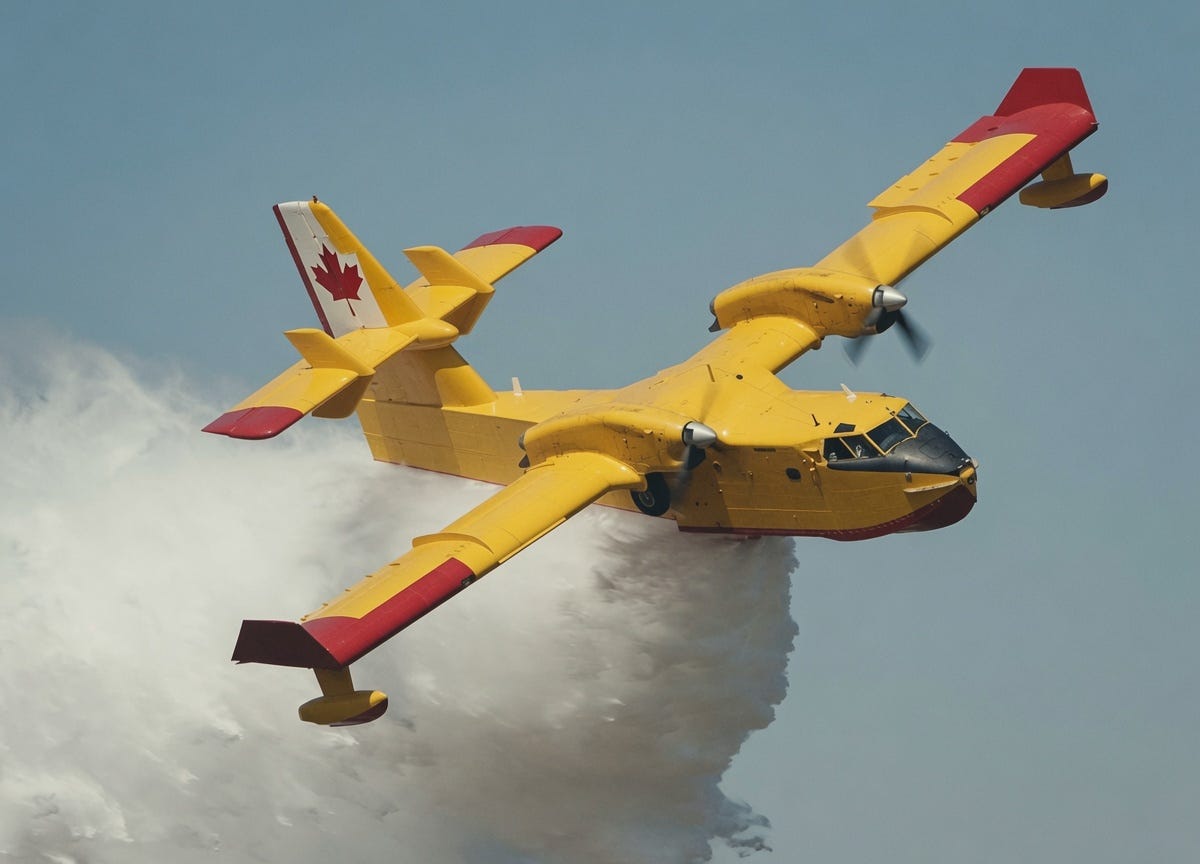
What exactly should the Americans be annoyed about?
Not the fires themselves. Outside of church buildings, lightning starts the majority of what burns in this country, in forests far from any road, and the agencies’ own cause data say so plainly, whatever one thinks of the surrounding climate rhetoric. Nobody in Ottawa lit those fires and nobody in Ottawa can unlight them.
The anger belongs elsewhere, and Canadians should direct it appropriately before reacting blindly to American concerns.
The promise
On 18 August 2021, at the Vancouver Convention Centre, in the middle of a general election, with large swaths of British Columbia burning behind him, Justin Trudeau declared that Canada was in a climate emergency. A re-elected Liberal government, he said, would invest $500 million ahead of the next fire season for the firefighters and equipment the provinces needed. To begin with, he promised to train at least 1,000 more firefighters. The document that accompanied the announcement supplied the details his remarks left out, pledging to work with provinces on equipment, including Canadian-made planes for aerial firefighting.
Consider what was knowable that afternoon. The Canadair CL-215 and CL-415, built in Quebec since the sixties and admired everywhere, were discontinued in 2015. De Havilland Canada would not announce the successor, the DHC-515, until March 2022, seven months after the promise. When the company announced it, the first 22 to 24 airframes were already committed to European buyers, and De Havilland stated plainly that it was not accepting orders from anyone else. Its own guidance put the earliest Canadian delivery around the end of this decade.
A promise of Canadian-made water bombers in August 2021 was a promise against a production line that did not exist, for delivery positions already sold to other governments. But that did not stop the prime minister, unconcerned about the press holding him accountable, from making an extravagant statement. British Columbia’s politicians were equally silent.
Nobody checked
Did anyone examine the claim at the time?
No contemporaneous fact-check of the aircraft pledge appears in the public record. What scrutiny existed that August went to the firefighter training number and the government’s emissions performance. The planes passed unremarked, and the reason is instructive. With no product, no price and no delivery schedule in existence, there was nothing to measure the promise against. A pledge measured against nothing cannot fail. For two years it did not, until reporters at CBC counted the country’s aircraft in the summer of 2023 and found Europe holding every early slot.
CBC reporters can ask questions. Nobody asked them during the election, and that was the problem.
I looked at this promise once before, two years to the week after it was made. Two observations from that piece have since been settled by events.
The first concerned the press. I wrote then that no reporter asked about the unfulfilled commitments even as fresh ones were issued. The record now shows something stronger than inattention.
The second concerned the provinces. I wrote that no evidence showed that any province had refused Ottawa’s offers, and that the need had only grown. Manitoba answered in April 2025 with $80 million down on three aircraft. Alberta answered in February 2026 with $400 million for five, bought off the new De Havilland line in Wheatland County outside Calgary. Both provinces moved as soon as they could. Both take delivery in 2031.
I wondered in 2023 whether Ottawa would have ordered dozens had the aircraft still been built in Montreal. The question is no longer hypothetical. The line opened outside Calgary, Alberta bought five off it with its own money, and Ottawa bought none. Draw whatever conclusion the evidence supports.
What arrived
Ottawa’s answer to its own emergency took the form of a federal grant program. Natural Resources Canada launched Fighting and Managing Wildfires in a Changing Climate in 2022, pairing a $256 million Equipment Fund with a $28 million Training Fund, both delivered to provinces and territories through cost-shared agreements. The arithmetic gives $284 million against a $500 million commitment.
By 7 September 2023, more than two fire seasons in and three months after smoke first closed New York, just over $65 million of the equipment money had been committed, across six agreements with Alberta, British Columbia, Nova Scotia, Saskatchewan, the Northwest Territories and Yukon. The federal release named what the money bought. Fire crew trucks and personal protective equipment.
On training, Ottawa’s own April 2024 accounting reported 630 firefighters and 125 fire guardians. Against 1,000, after nearly three years. In fairness to the Trudeau crew, delivering 60 percent of a promise in twice the promised time may count as one of their rarer accomplishments.
Federal water bombers purchased: none.
Ottawa leases what it promised to buy
Something did arrive this year. In February 2026, the federal government announced the Pan-Canadian Aerial Assets Program, $316.7 million over five years from Budget 2025, directed through the Canadian Interagency Forest Fire Centre. On 25 May, Emergency Management Minister Eleanor Olszewski unveiled the result: four air tankers, one birddog aircraft, five heavy-lift helicopters and two mobile tanker bases, available to provinces on request.
Every one of them is rented. CIFFC holds 150-day contracts running from the first of May to the twenty-seventh of September. Canada owns nothing. When the contracts expire in the autumn, the fleet goes home.
The suppliers deserve a mention because they answer a question the announcement did not raise. All three are Canadian, and all three are British Columbian. Conair Group of Abbotsford supplies the air tankers and the birddog. Coldstream Helicopters of Kelowna and VIH Helicopters of North Saanich supply the rotary wing. Conair builds four new Dash 8-400 airtankers every year and says it can increase production if anyone asks.
Read that last sentence again. Canadian firms build aerial firefighting aircraft at a rate they are willing to raise, and the Government of Canada rents from them by the season.
Olszewski defended the decision to lease rather than buy, and her reasoning deserves the closest possible reading. Purchasing an aircraft, she explained, means a wait of three to five years, potentially longer. Leasing gives flexibility about timing.
The minister is entirely correct. Buying aircraft takes three to five years. Common sense of that order escaped the prime minister in 2021, and the press missed it with him.
Her defence raises a question the announcement did not answer. Leasing requires no production line, no European delivery queue and no lead time at all. Conair, Coldstream and VIH were flying in 2021, with fleets in service and crews trained. Every argument the minister makes for renting rather than buying, the speed and the flexibility and the fit to a season, applied with equal force in the spring of 2022, and in 2023, and in every season since. Four and a half years separate the promise from the lease.
Whatever delayed the aircraft, manufacturing did not.
The provinces did it themselves
Manitoba put down $80 million in April 2025. Alberta committed $400 million in February 2026, money Premier Smith noted sits separate from the $160 million the province already spends each year on wildfire response. Ontario has spent $650 million on five helicopters and five water bombers, and Premier Ford now asks Ottawa for more. Newfoundland and Labrador has just awarded a $17 million contract to return a single CL-415 to service after seven seasons on the ground.
Nothing is wrong with provinces doing things themselves. Forest management belongs to them; they know their own country, and a federation works better when they act. The difficulty is narrower. Ottawa promised to help buy the aircraft, collected the credit for saying so, and then left four provincial treasuries to do the buying alone.
The Senate reached its own verdict last month. The Standing Committee on Agriculture and Forestry released Canada on Fire on 10 June, and the chamber adopted it the following day, starting a 150-day clock for the government to respond. The report found Canada’s patchwork of municipal, provincial and federal responses too slow for the pace of modern fire and issued 15 recommendations. Two of them matter here. Create a federal coordinating office. Build a permanent aircraft fleet.
Five years after Ottawa promised the planes, the Senate has to recommend that Ottawa acquire some, and the government has 150 days merely to reply. Oh, and create more federal bureaucracy while they are at it. One can see why American legislators will go on being annoyed.
What Canada never told its neighbours
One more fact belongs before the Americans, and no Canadian official has ever volunteered it.
Canada does not fight most of what burns. Agencies sort every fire into full, modified or monitored response. Work by Cordy Tymstra, Brian Stocks, Xinli Cai and Mike Flannigan, published in Progress in Disaster Science in 2020, found that fires assigned a modified response made up 9 percent of reported fires between 1997 and 2016 while accounting for roughly 64 percent of all area burned. Saskatchewan and the Northwest Territories alone produce half of that.
Read it plainly. Roughly two-thirds of the hectares that generate the smoke over Michigan come from fires Canadian agencies assessed and then chose to leave largely alone.
Part of the reasoning is ecological and sound. Suppressing every fire in a forest built to burn produces worse fires later, and nobody patrols three million square kilometres.
Part of the reasoning is money, and the same four authors say so. They give three reasons for the shift to risk-based response: the disastrous seasons and the reviews that followed them, the recognition of fire’s ecological role, and the need to control costs. Cost sits in that sentence as an equal, written by the people who know the file best. Suppression has run between $800 million and $1.5 billion a year over the past decade. The 2003 season that prompted the Canadian Wildland Fire Strategy cost close to a billion on its own.
Now set that beside the language Ottawa uses about fire. A climate emergency. An existential threat. A planet requiring salvation.
No municipality decommissions its fire hydrants mid-blaze to protect a budget line. Emergencies are the one category of public spending where cost no longer functions as an argument. That is what the word means. A government that declares an emergency and then economizes on the response has told you which of its two statements it believes.
The contradiction runs deeper than budgeting. Canada’s own National Inventory Report puts the carbon released by the 2023 fires at close to one gigatonne of carbon dioxide, exceeding the total emissions from every other Canadian source combined that year. Independent work published in Nature reached a comparable magnitude and concluded that, ranked by country, the fires would have placed fourth among global emitters. A policy of leaving roughly two-thirds of the burned area largely unfought, adopted partly to control costs, is therefore also a policy of permitting the largest carbon release in Canadian history.
More fires to save the planet.
So how does Ottawa hold both positions at once? By not counting. Wildfire emissions appear in the National Inventory Report and then sit outside the official tally Canada reports and legislates against. The largest carbon event in the country’s history never enters the ledger used to justify the emergency. Citizens pay against the smaller number. The fires are exempt from the arithmetic they are cited to prove.
Let us recall that this is the government that priced carbon to the tonne for a farmer drying his grain, and then left a gigatonne off the books because lightning put it there.
Canada could still make the honest case to Washington tomorrow. Two-thirds of the smoke comes from fires we assess and leave, for ecological reasons and for fiscal ones, and here is why that is defensible. Washington might even accept it.
The opening was wider than that, and it has closed. Joe Biden shared the doomsday expectation Trudeau performed, which made him the most receptive American president Canada was ever going to get on this file. Ottawa could have traded on that vision and secured American help in fighting and containing the fires that smoke out American cities. Quebec and British Columbia have sent aircraft south for years, including to the Palisades fire in January 2025, where an American hobbyist’s drone collided with a Canadian water bomber and grounded it. The traffic across that border has never run one way, and a serious government would have built something durable on it. Add the file to the list of things the Trudeau years left on the table.
Ottawa never made the case. Ottawa preferred announcements.
However you look at it, the American complaint is not outlandish
So the Americans are angry at the wrong thing, but they are not wrong to be angry. Their letter demands better forest management, which would change almost nothing, from a federal government that does not manage the forests and could not change it if it did. What deserves the anger is a government that met a continental emergency of its own, declaring by promising aircraft it could not obtain, spending a fraction of what it pledged, training a fraction of whom it promised, and renting by the season what four provinces went out and bought.
Genuine emergencies produce purchases. This one produced a leasing arrangement and a Senate committee recommendation that somebody eventually buy a plane.
Trudeau said he would act ahead of the next fire season. Five fire seasons have passed.
Canadians own this one. Laurentians are responsible.
It seemed bizarre that American politicians reacted to the Ontario wildfires the way they did, but this essay explains why.
Regardless of where we stand on the Russia-Ukraine war, the Canadian government's first fiduciary duty is to Canada and Canadians. After sending hundreds of millions of taxpayer dollars to Ukraine, and elsewhere it should be held accountable for its wasteful spending decisions and the promises it made and never kept.
Thank you for this essay. I wasn't aware of these facts before, and I appreciate having a fuller understanding now.
It is difficult to imagine our Country being any more poorly managed than it is at the moment.
Yes, Canadians own this one.