

He Yells. At Whom?

Let me start with a note on the source: Althia Raj is a national political columnist for the Toronto Star, not a hostile witness. The Star has not been a reluctant supporter of Mark Carney or of the Liberal project that produced him. When a columnist of that profile publishes a piece headlined ‘He yells’, sourced to multiple anonymous Liberal MPs describing a prime minister who ‘punches down at caucus all the time’, that is not the Conservative Party research bureau at work. That is the establishment press corps signalling that the usual norms of protective coverage are under strain.
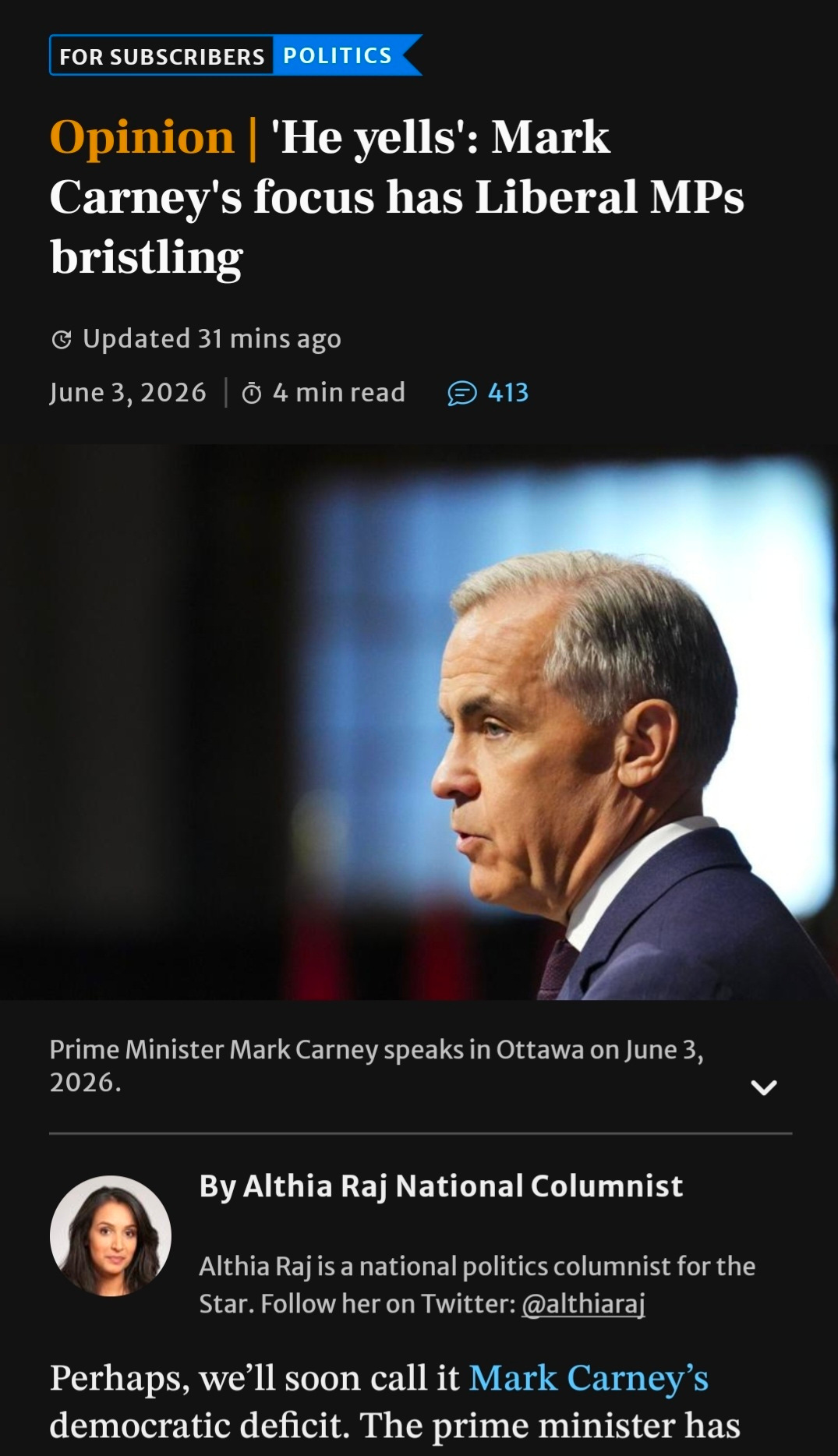
To whom does he yell?
The article names names. Nova Scotia MP Jaime Battiste raised concerns about the government’s changes to the Indian Act and received what the piece calls a stunning rebuke. Winnipeg MP Doug Eyolfson, a physician, was told not to bring his concerns about Alberta’s health care Bill 11 to the prime minister. Laval MP Angelo Iacono asked Carney to visit his riding and was told Carney had already been there recently. He had not. These are not anonymous composites. They are named sitting MPs describing specific exchanges. The experiences, Raj writes, left a lasting imprint.
One MP, speaking on condition of anonymity to avoid retribution from the Prime Minister’s Office, put the situation plainly: ‘He yells. He punches down at caucus all the time.’
The phrase ‘to avoid retribution from the Prime Minister’s Office’ belongs in the ledger of things Canadians should notice. That is not a description of a demanding boss. That is a description of a punitive one.
The Paper Trail
Caucus chair James Maloney told Liberal MPs this week not to talk to journalists or write to the prime minister about their concerns, because their letters could leak. In late April, thirteen MPs sent Carney an email about his government’s memorandum of understanding with Alberta and the Liberals’ climate agenda. The letter leaked. The lesson drawn was not that the policy needed better explaining. The lesson drawn was that MPs should not write letters.
In parallel, the government is proposing to weaken the already dysfunctional Access to Information regime. Journalist Dean Beeby first noticed the consultation document proposing to legally deny access to some frequent users of the system (journalists being the obvious candidates) and to remove emails and text messages entirely from the law’s scope. The consultation period runs until June 15. You have a few days to do some yelling of your own.
Read together, these moves form a single pattern. It is Carney’s government and Carney’s agenda. Do not bother him with disagreements. Do not speak to journalists. Do not write to the prime minister. Leave no paper trail. Amend the law so that any existing paper trail cannot be retrieved. A word about his trouble answering questions from female journalists would fit neatly here too.
This is not message discipline. Message discipline is a communications strategy. What Raj describes is a structural effort to eliminate the feedback mechanisms that allow parliamentary government to function and a free press to scrutinize it. The instinct mirrors the Trudeau government’s attempt, despite all his rhetoric about open government, to shield ministerial exempt-staff emails from access-to-information requests.
Democracy at the Riding Level
Carney has yet to hold an open nomination in any byelection. When Bill Blair and Chrystia Freeland left Parliament, Carney appointed physician Danielle Martin and NDP MPP Doly Begum as Liberal candidates in Toronto and Scarborough, preventing local members from having a say. Internal expectations are that he will also appoint candidates for the upcoming North Vancouver byelection, where his own deputy chief of staff is reportedly interested in the seat.
A prime minister who distrusts caucus members’ opinions distrusts the people who elected them. A prime minister who distrusts the nomination process distrusts the people who would participate in it. Power flows inward, toward the centre, toward the office, away from the representative machinery that is supposed to give the exercise of that power its legitimacy. Power comes down from one source.
The Management Type
Carney has told caucus he does not want to hear about problems. He wants solutions. A new leader setting a high bar is legitimate. But a caucus is an early warning system. An MP raising a concern about changes to the Indian Act or Alberta health care legislation is not obstructing the agenda. Shutting that down is not running a tight ship. Shutting that down risks navigating blind, and politics never shies away from offering shallow waters.
The management profile this describes is recognizable. It appears among leaders who come from high-achievement professional backgrounds, with a high self-concept and a low tolerance for subordinates’ autonomous judgment. Julie Payette arrived at Rideau Hall with a distinguished record and no preparation for a role that required deference to process over personal authority. The independent workplace review that precipitated her resignation detailed yelling, public humiliation, and aggressive conduct toward staff. Alison Redford’s caucus fractured along similar lines in Alberta, with sitting MLAs using the words ‘abusive’ and ‘bully’ before resigning. The presenting scandal was the pretext. The management style was the grievance.
The relevant question is whether the pattern will follow the same trajectory. Carney’s majority is partly assembled from floor-crossing Conservatives whose loyalty is personal and provisional. It is contingent on power. His caucus voted down the Reform Act’s accountability mechanisms early in the mandate. His PMO apparently treats retribution as a credible threat. That is not a stable political architecture for the long stretch between elections.
The Trudeau Contrast Is Not What Defenders Think
The complaints about Carney’s style may be the natural issues that rise in a transition from one leader to another. Justin Trudeau expected nothing of caucus because he expected nothing of himself. He wanted the title and the glamour of the office. Carney seems to want results. A leader who reads the briefing books and holds people to account for outcomes is not the same as a leader who holds court once a week, one might say. And Trudeau didn’t listen to his MPs either.
Westminster cabinet government is not a corporation, however. The prime minister is not a chief executive with a compliant board but first among equals, operating within an institution whose legitimacy depends on elected members who answer to constituents, not to the PMO. Carney’s entire professional formation was in central banks and international bodies where accountability runs upward to governors and downward to staff, not sideways to colleagues with independent political bases. Those habits do not transfer cleanly. A central bank governor does not negotiate rate decisions the way a prime minister must negotiate legislative priorities with 170 MPs elected by people who were impressed by the governor’s biography 15 months ago.
Carney’s majority was assembled, in part, by poaching opposition MPs. He may not have earned real caucus support yet.
* * *
The article Raj published is an opinion piece, and The Star is what it is. Neither fact changes what the piece contains: named MPs, described incidents, and a structural critique that the reporter, by her own publication record, had no motive to manufacture. When a loyalist starts asking whether the government wants Canadians to know what is happening, the honeymoon is over. The question now is whether Prime Minister Carney will treat this as an early warning signal or as a leak to be traced.
The answer to that question will tell Canadians more about the next four years than any contrived speech delivered to a camera.
I enjoyed the article very much.
I couldn’t help thinking of my own Liberal MP, Peter Fragiskatos.
Peter’s nickname is “The Undertaker.”
He doesn’t smile, he doesn’t speak, he has no opinions, or ideas: he just climbs over the bodies.
He voted for every single initiative presented by the “former” government.
He has been referred to as the “Sgt. Schultz of MPs: he knows nothing, he sees nothing, he does nothing.
He collects his pay. He speaks when spoken to. He has neither mustered nor spoken an independent thought in eleven years. I doubt the “Diminutive Diva of Davos” even knows his name.
Speaking of which, how many folks out there have experienced a boss with “small man syndrome”.
I have. That is precisely of what Prime Minister Carney reminds one.
It is important to remember one thing about bosses afflicted similarly: that is, when things go wrong, not one of those MPs will waste a piss even if the boss’s hair were on fire.
Splendid article, and stellar Canadian commentary.
Thanks for another insightful commentary. Carney to me appears to believe in top down interventionism and managerialism ......an arrogant technocrat who thinks society is a collection of problems to be managed.