

Net Zero, Zero Accountability

What follows is not fresh news. It has been reported, although it is not all that widely known. The point of writing about this now is not to focus on the failure of a purchase or program. Things fail. The point here is that it has become a trend for things to fail in public life due to false promises and so on, but no one pays any price but the public. This is written as a reminder and as a call to action. Unless there are stricter mechanisms for accountability, nothing prevents what you are about to read from happening again and again.
The Supreme Court of Canada heard arguments this week in the WE Charity case, but it is no longer about Justin Trudeau. Trudeau is gone. What remains is the unresolved question that refuses to go away: who, exactly, can challenge a catastrophic public decision when everyone involved is said to have followed the rules?
Right now, the answer is effectively no one. And that is not only at the federal level.
Take the procurement and purchase of electric buses in Edmonton and Calgary. Edmonton committed to 40 Proterra electric buses and purpose-built charging garages, then watched the supplier enter bankruptcy protection and watched the city’s claim climb to $82 million. Calgary watched that sequence unfold, then approved 120 battery-electric buses at $1.72 million per bus, “about 40 per cent more than diesel,” and built a funding stack that tops $440 million. Both cities wrapped their decisions in the language of climate emergency and planetary stewardship. Both cities treated scrutiny as an obstruction.
The green transition has become its own justification for public action. When you are saving the planet, and you have convinced yourself that you are living in a climate emergency, who stops to ask whether the buses actually work in winter?
The promise
Edmonton started this story with a press release and a ribbon-cutting mood. In July 2020, Edmonton Transit Service and Proterra unveiled the first 21 buses and announced that ETS had “19 more Proterra buses on the way this year to make up a 40-bus fleet.” The same release framed the purchase as “one of the largest purchases of electric buses in Canadian history.” Turned out ourchasing the buses made history in Edmonton for several other reasons.
Then-mayor Don Iveson was enthusiastic. He called the new buses “super-efficient” and “particularly efficient financially.” Though they cost more upfront, “more than $1 million each,” Iveson promised they would be about 30 per cent less expensive to service and maintain than diesel buses. Global News reported claims that the buses could travel “up to 350 km on a single charge” and that “the batteries work in all weather conditions.”
Those sentences roughly capture the mindset that made this possible at the time. Edmontonians bought it. The City of Edmonton treated winter as a footnote. Edmonton! Edmonton sits at 53 degrees north latitude. January average temperatures hover around minus 10 Celsius, with cold snaps routinely plunging to minus 35 and beyond. Anyone who has tried to start a car in an Alberta January knows what cold does to batteries. But Edmonton’s planners, drunk with enthusiasm for the new vehicles, spoke as though thermodynamics bent to good intentions.
This is what happens when climate righteousness displaces common sense and engineering caution. The moral urgency of net-zero targets, “the sense that the planet’s survival depends on immediate action,” not to mention the appearance of embracing superior virtue, creates pressure to adopt, to announce, to lead. It gets votes among naive Edmontonians. Nobody wants to be the skeptic who slows the so-called transition into the future. Nobody wants to be the bureaucrat who asked inconvenient questions about range degradation at minus 25. So the questions go unasked, and the ribbon gets cut. No one wants to say “due diligence.”
The collapse
The Canadian Prairies teach their lessons quickly when those Northern winds rush in unimpeded. Batteries lose range in the cold, and supply chains break at the worst moment. Even vehicles that have been tried and tested to operate in such conditions occasionally give in. Life in the northern Prairie is not for the faint of heart.
Taproot Edmonton reported in August 2023 that Proterra, “the U.S.-based company that built 60 electric buses for the Edmonton Transit Service,” filed for Chapter 11 bankruptcy protection. Ultimately, it was not Canada’s winter that defeated Proterra. Did I mention that Proterra was based in California? Court documents listed “the City of Edmonton” with “an unsecured claim of more than $8 million in deferred revenue.”
Edmonton’s planners and bureaucrats left Edmontonians holding the bag. Taproot did not need to editorialize. Bankruptcy court filings supply their own punchline. Edmonton did not hold an asset. Edmonton held a claim.
Then the claim ballooned. By February 2024, Taproot reported that “the City of Edmonton’s claim against U.S. electric bus manufacturer Proterra has increased to $82 million.” Court filings argued the buses “have consistently underperformed due to inadequate battery range and structural problems.” Within a year, the problem got 10 times worse.
The underperformance was not subtle. CBC reported that by late 2023, only 16 of Edmonton’s 60 electric buses were fit to be on the roads on a given morning. A transit union representative told reporters that some buses had been out of service for over a year, waiting for parts. The city’s lawyers wrote in court filings that the buses failed to meet contract requirements regarding range, battery life, reliability, and durability. The actual winter range, they alleged, was about 165 kilometres, roughly 100 kilometres short of what was promised even for extreme cold conditions. The city spent more than $200,000 on “battery blankets” to keep batteries warm and working. It did not help enough. Let me say it again, northern Prairie winters are not for the faint of heart.
That sequence contains the entire governance indictment in miniature. Edmonton paid for a fleet. Edmonton received a fleet that underperformed. Edmonton now holds an unsecured claim in a U.S. bankruptcy proceeding. How fun is that?
What is fun for the Edmonton bureaucracy and city planners is that nobody paid a professional price. Mayor Iveson had already moved on, his term ending in 2021. The administrators who approved the procurement remain employed. The consultants who blessed all the overblown assumptions have other contracts. Life in Canadian municipal employment is good.
Update: Proterra emerged from Chapter 11 bankruptcy in March 2024 after selling off its transit bus division to Phoenix Motor Inc. for approximately $10 million plus assumed liabilities. But days before the sale hearing, Edmonton was removed from the list of contracts to be assumed by the buyer. Proterra then filed a motion to reject Edmonton’s contract entirely, meaning the warranty provisions and service obligations will not be honoured. It is a gift that keeps on taking away. A Vancouver insolvency lawyer told CBC that Edmonton, as an unsecured creditor, would probably recover “pennies on the dollar.” Maybe. Need we be reminded that the same people who lied about their vehicles' capabilities? The reorganization plan promised “a meaningful recovery to holders of unsecured claims,” but no specific figures have been announced for Edmonton’s $82 million claim. The city’s buses remain in service, the handful that occasionally work, with no manufacturer standing behind them.
Calgary proceeds anyway
The City planners in Calgary watched all of this unfold. Calgary had Edmonton’s experience documented in court filings and news reports. Calgary had time to ask whether the same risks applied to its own climate and operating conditions. They wasted that time.
Calgary proceeded anyway, and Calgary wrote down the cost premium in plain language.
Calgary Transit’s own project page answered the key question directly: “The current cost per bus is $1.72 million, which is 40 per cent more than the cost of conventional diesel buses.” Calgary Transit also wrote the justification without embarrassment: “With federal funding and financing specific for electric buses, we can buy more buses (120 units) than just using City funding (80-90 diesel units).” This is not the first time I have seen municipal officials in Canada treat money from other levels of government as “free” money.
Calgary did not hide the “incentive” structure. Calgary printed it. The logic was explicit: Ottawa and the Canada Infrastructure Bank would provide enough subsidized financing that Calgary could buy more electric buses than it could afford with its own money. The environmental benefit was assumed. The financial risk was distributed. The moral imperative was invoked. Planet-saving with other people’s money: It must be done.
Climate alarmist Mayor Jyoti Gondek framed the decision in precisely these terms. At the October 2022 committee meeting that approved the plan, Gondek told reporters that the city’s ability to put $100 million in and get $400 million out was “incredible.” For every dollar Calgary was putting in, she said, it appeared to be receiving four dollars back. This is the math of the subsidy treadmill: the municipal bureaucratic soul measures success by the ratio of dollars captured, from the feds or the province, not by the performance of the assets purchased. Not by the service delivered.
Calgary published the funding stack in the same place. Calgary Transit listed “Grant funding (up to $220 million),” “Canada Infrastructure Bank (CIB) financing (up to $123 million),” and “City funding ($100 million).” Those numbers land north of $440 million before anyone adds contingencies or cost creep. What a coup, eh?!
Trudeau’s Ottawa published parallel numbers with a broader scope. Infrastructure Canada announced in June 2023 that the federal government would invest “more than $325 million” to support the electrification of Calgary’s transit buses. The same announcement said the investment “builds on a $165 million investment from the Canada Infrastructure Bank” and “will allow the City of Calgary to purchase and deploy up to 259” zero-emission buses. The language was saturated with hubris and climate ambition: “greener future,” “zero emission,” “net-zero emissions targets.” In reality, these acted more like magical words that conjured a green reality.
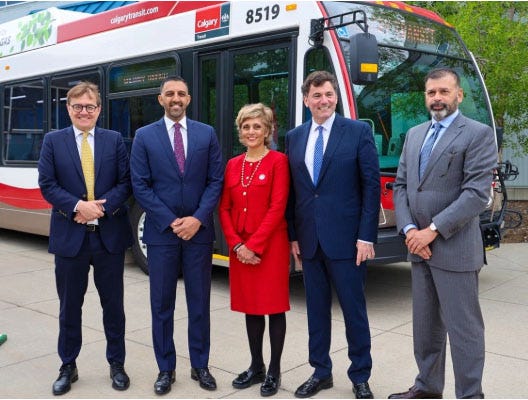
This is the magical vocabulary that insulates decisions from scrutiny. When spending is framed as planetary salvation, questions about procurement risk or winter performance are obstacles to progress. When federal ministers announce investments alongside local mayors (See Jonathan Wilkis and Dominic Leblanc beaming in the picture at the Calgary announcement ceremony), the political incentives align toward adoption, not caution. Everyone in the photo wants to be seen acting virtuously on climate. Nobody in the photo wants to be seen asking whether the buses will work when it is minus 30.
Ottawa, the CIB, and Calgary all aligned in the same direction. Calgary still faced the same basic question Edmonton faced. Calgary still faced winter, lifecycle risk, supplier risk, charging constraints, and fleet availability. But it preferred to turn away from them.
Calgary had an additional input that Edmonton lacked. Calgary had Edmonton’s lived experience. Calgary chose not to learn from it. No one would stand in the way of an alarmist mayor who declared a climate emergency on the first day of her mandate.
The missing document
Edmonton supplied that experience in documents, not just anecdotes. Edmonton’s 2020 ETS branch highlights report stated: “ETS’ 40 electric buses is one of the single largest purchases of electric buses in Canadian history.” The same report expressed high operational confidence and predicted lower servicing costs. The city’s planning language treated electrification as a strategic upgrade.
Then the city faced company bankruptcy and vehicle underperformance.
So, Calgary decided to proceed with a different supplier. In August 2025, Calgary Transit announced the procurement of 120 new electric buses and linked the decision to federal support and diversification of fuel sources. Calgary leaned on lifecycle savings. Global News reported in December 2025 that Calgary expected to save “nearly $900,000 per electric bus” over the lifespan compared to diesel, citing a city memo.
Calgary thus argued for cost discipline while paying a 40 per cent premium upfront. Calgary asked the public to accept the premium today for promised savings later, while Edmonton litigated its way out of yesterday’s promises. The assumptions behind the lifecycle savings, battery longevity, maintenance costs, resale value, and electricity prices were not subjected to the stress test that Edmonton’s experience provided. No one even tried. There is no record that anyone raised the question. The assumptions were simply asserted, wrapped in the spell-bound confidence of climate necessity.
The accountability problem sits in the seams between those documents.
Edmonton’s record shows the city celebrated scale and novelty, then absorbed failure without visible career consequences. Calgary’s record shows the city acknowledged the premium, then justified it through federal money, then embedded the plan into its long-term strategy. All procedural.
Nobody wrote down a consequence.
No document in this chain says: council fires a manager if the buses cannot meet winter range. No document says: procurement stops if a vendor collapses. No document says: council claws back bonuses if assumptions fail. The system rewards adoption and compliance, and it treats failure as a technical appendix. The climate emergency framework that justified urgent action also justified dispensing with the skepticism that might have caught the problem earlier. Trouble can always be swept under a giant rug, and if it comes out, the media attention will not last more than a few minutes. Life goes on. No one is paying serious attention.
The opportunity cost
The opportunity cost does not require poetry. It requires arithmetic.
Use a conservative supportive-housing estimate of $40,000 per person per year. That’s roughly what it takes to take a person off the streets and into proper housing. Edmonton’s $82 million claim equals about 2,050 person-years of housing support at that rate. Calgary’s roughly $443 million in local funding equates to about 11,000 homeless person-years. Ottawa’s $325 million federal grant equals about 8,125 person-years.
Those rough comparisons do not prove a housing solution. They only demonstrate scale. They show what else could have been done with the money that was instead committed to a technology adoption project wrapped in the language of existential necessity.
Edmonton and Calgary did not spend spare change. Edmonton and Calgary committed sums large enough to change the trajectory of other urgent files, then treated accountability as optional. Still do.
That pattern continues because the incentive structure continues. Ottawa writes cheques for “transition.” The CIB finances “transition.” Cities approve “transition.” The word itself carries moral weight that forecloses debate. Who opposes planet-saving transition? Who stands in the way of a greener future? The framing ensures that critics and policy realists are cast as climate deniers or obstacles to progress rather than as prudent stewards of public money asking reasonable questions about risk.
Nobody builds a mechanism that attaches personal responsibility to failure.
Net zero thus becomes a label that protects decisions from scrutiny. The righteousness of the goal absorbs the cost of the failure, any cost. When the buses do not work, the response is not accountability but doubling down: the transition must continue, the investment must be honoured, the next round of funding must be secured. The alternative, admitting that the approach was flawed, is ideologically unthinkable. It might suggest to some that their ideology is bunk.
The documents show the numbers. The documents show the targets. The documents show the premiums. The documents show the claims. The documents do not show consequences.
The constitutional frame
Trudeau is gone. So is Don Iveson. Jyoti Gondek lost her re-election bid in October 2025. The mayors who championed Alberta’s electric-bus spending have moved on, their tenures ended. But the buses remain, underperforming or idled, and the claims remain, unsecured and unlikely to be paid in full. The taxpayer is holding the bag.
The WE Charity case shows how Ottawa can turn watchdogs into shields. Edmonton and Calgary show how committees, audits, and climate frameworks perform the same protective function. Different levels of government. A very similar accountability vacuum.
The Supreme Court case now supplies a constitutional vocabulary for what Alberta’s electric-bus files already demonstrate municipally: public money can be committed at enormous scale, risks can be acknowledged in advance, outcomes can fail, and yet no one can be meaningfully challenged after the fact. Half a billion dollars gone. Oh, what a terrible thing, eh?!
It should be said that the green transition did not create this accountability vacuum. In Canada, it exists just about everywhere. But the moral urgency of climate action has significantly widened it. When every expenditure is framed as planetary necessity, when every delay is framed as climate denial, the ordinary mechanisms of scrutiny, procurement reviews, risk assessments, and performance benchmarks become obstacles to be overcome rather than safeguards to be honoured. Asking the question can end careers, and bureaucracies are replete with careerists — people who answer to no principles but the imperative to keep their cushy jobs and benefits, come what may.
Edmonton bought buses that do not work in winter. Calgary outdid them and bought even more. The planet is not noticeably cooler or warmer. The taxpayers are noticeably poorer. And nobody, not one person, is responsible.
---
References
[Edmonton Transit Service and Proterra announcement](https://www.newswire.ca/news-releases/edmonton-transit-service-unveils-fleet-of-record-breaking-proterra-catalyst-r-e2-max-electric-buses-and-innovative-electric-bus-garages-879704027.html) (Newswire, July 23, 2020)
[Edmonton debuts fleet of new electric buses](https://globalnews.ca/news/7210590/edmonton-electric-buses/) (Global News, July 23, 2020)
[Edmonton’s electric bus supplier files for bankruptcy protection](https://edmonton.taproot.news/news/2023/08/18/edmontons-electric-bus-supplier-files-for-bankruptcy-protection) (Taproot Edmonton, Aug 18, 2023)
[Headlines: claim increased to $82 million](https://edmonton.taproot.news/briefs/2024/02/13/headlines-feb-13-2024) (Taproot Edmonton, Feb 13, 2024)
[Edmonton’s fleet of electric buses failing amid manufacturer’s bankruptcy proceedings](https://www.cbc.ca/news/canada/edmonton/edmonton-buses-proterra-1.7035186) (CBC, Nov 22, 2023)
[City of Edmonton’s claim against electric bus manufacturer balloons to $82M](https://www.cbc.ca/news/canada/edmonton/city-of-edmonton-proterra-claim-1.7112611) (CBC, Feb 12, 2024)
[40-Foot Electric Buses project page](https://www.calgarytransit.com/plans---projects/40-foot-electric-buses.html) (Calgary Transit)
[Calgary committee approves plan to seek financing for 259 electric buses](https://livewirecalgary.com/2022/10/18/calgary-committee-approves-plan-to-seek-financing-for-259-electric-buses/) (LiveWire Calgary, Oct 18, 2022)
[Canada and Calgary invest in greener public transit](https://www.canada.ca/en/housing-infrastructure-communities/news/2023/06/canada-and-calgary-invest-in-greener-future-for-public-transit-in-the-city.html) (Government of Canada, June 19, 2023)
[City of Calgary Zero-Emission Buses project](https://cib-bic.ca/en/projects/public-transit/city-of-calgary-zero-emission-buses/) (Canada Infrastructure Bank)
[Calgary Transit expands fleet](https://newsroom.calgary.ca/calgary-transit-expands-fleet-to-support-reliable-affordable-service/) (Calgary Newsroom, Aug 8, 2025)
[Calgary expects nearly $900K savings per bus over lifecycle](https://globalnews.ca/news/11554246/calgary-savings-electric-buses-memo/) (Global News, Dec 1, 2025)
[New electric buses save estimated $900K in lifecycle costs](https://livewirecalgary.com/2025/11/28/new-electric-buses-save-estimate-900k-lifecycle-costs-memo/) (LiveWire Calgary, Nov 28, 2025)
[Proterra Emerges From Chapter 11](https://www.paulweiss.com/practices/transactional/restructuring/news/proterra-emerges-from-chapter-11) (Paul, Weiss)
“What remains is the unresolved question that refuses to go away: who, exactly, can challenge a catastrophic public decision when everyone involved is said to have followed the rules?”
Who, indeed?
This is brilliant Canadian journalism.
Bravo.
Outstanding breakdown of how climate urgency functionsas a shield against basic due diligence. The Calgary-after-Edmonton sequence is the most damning part because it proves this isn't about information gaps, it's about incentive structures that reward adoption regardless of outcome. My brother works in municipal procurement and says the phrase 'federal money' literally ends risk discussions in meetings. That shift from stewardship to subsidy maximization explains why half a billion evaporates with zero consequences.