

Sunny Ways, Declining Days
A Decade of Trudeau and the Collapse of Canadian Happiness

SUNNY WAYS
The moment arrived on October 20, 2015, at a Montreal ballroom overflowing with believers. Justin Trudeau, having just formed a surprise majority government, smiled into the lights and delivered the line that would define the next decade of Canadian political mythology.
“Sunny ways, my friends, sunny ways. This is what positive politics can do. This is what a positive, hopeful vision and a big bold plan can make happen.”
The crowd responded as crowds respond to exactly that sort of thing: with the joy that comes from believing history has changed direction. Canada, Trudeau announced that night, was back. Better, he had told voters throughout the campaign, was always possible. (A line Naheed Nenshi politicking in Alberta incessantly borrows from JT.)
Few prime ministers in Canadian history arrived with a more comprehensively articulated coalition. Young Canadians voted Liberal at rates not seen in a generation. Elections Canada confirmed that turnout among voters aged 18 to 24 increased by 18.3 percentage points in 2015, the largest jump for that age group since the agency began tracking demographic data in 2004. Nearly half of Canadians aged 18 to 34 supported the Liberal Party. They did not merely vote for Trudeau; they participated, many for the first time, because they believed the stakes were real and the candidate was theirs. (Why do you think progressives want to lower the voting age even further?)
Indigenous voters turned out in matching numbers. On reserves, turnout increased 14 percentage points over 2011. Trudeau had been courting those communities explicitly, speaking a language of relationship and repair that his predecessor had pointedly refused. At a Vice magazine town hall in October 2015, he promised to end all boil-water advisories on First Nations reserves within five years. Ninety-three communities, he noted, were living under 133 different advisories. He would fix it.
The commitments reached into virtually every dimension of civic life. Electoral reform to end first-past-the-post, because the 2015 election would be the last under that system. A nation-to-nation relationship with Indigenous peoples, because, in his own telling, there was “no relationship more important to me, and to Canada, than the one with First Nations, the Metis Nation, and Inuit.” A feminist cabinet, announced on his first day in office with a three-word response to a reporter’s question: “Because it’s 2015.” Climate action built around a carbon price. Housing investment. A more generous, more expansive, more inclusive Canada.
The brand was spectacular. The photography was impeccable. The language was generous and the intentions, in the estimation of his supporters, were pure. Young Canadians, Indigenous communities, women, LGBTQ+ Canadians, racialized minorities, and progressive voters of every description placed their trust in a man who seemed, genuinely, to represent something new.
What they got instead is now measurable. The measuring instrument is the World Happiness Report, and Canada appears in it year after year, with its ranking declining.
THE INDEX DOES NOT LIE
The World Happiness Report, published annually since 2016 by the Wellbeing Research Centre at the University of Oxford in partnership with Gallup and the United Nations Sustainable Development Solutions Network, ranks countries by self-reported life evaluations collected through the Gallup World Poll. Respondents rate their own lives on a zero-to-ten scale. National averages, calculated as three-year rolling means to reduce volatility, determine each country’s position. The methodology is rigorous. The results, for Canada, are damning.
The report was not published in 2014, and the 2015 edition used data averaged across 2012 to 2014 -- the last full measure of Canada before the Trudeau era began. That report placed Canada fifth in the world, with a score of 7.43. The 2026 World Happiness Report, released March 19, 2026, is the most recent available and captures the Gallup average for 2023 to 2025. Canada stands at twenty-fifth. The score is 6.741. Twenty positions lost. Seven-tenths of a point erased on a ten-point scale.
Canada’s complete record across every published report:
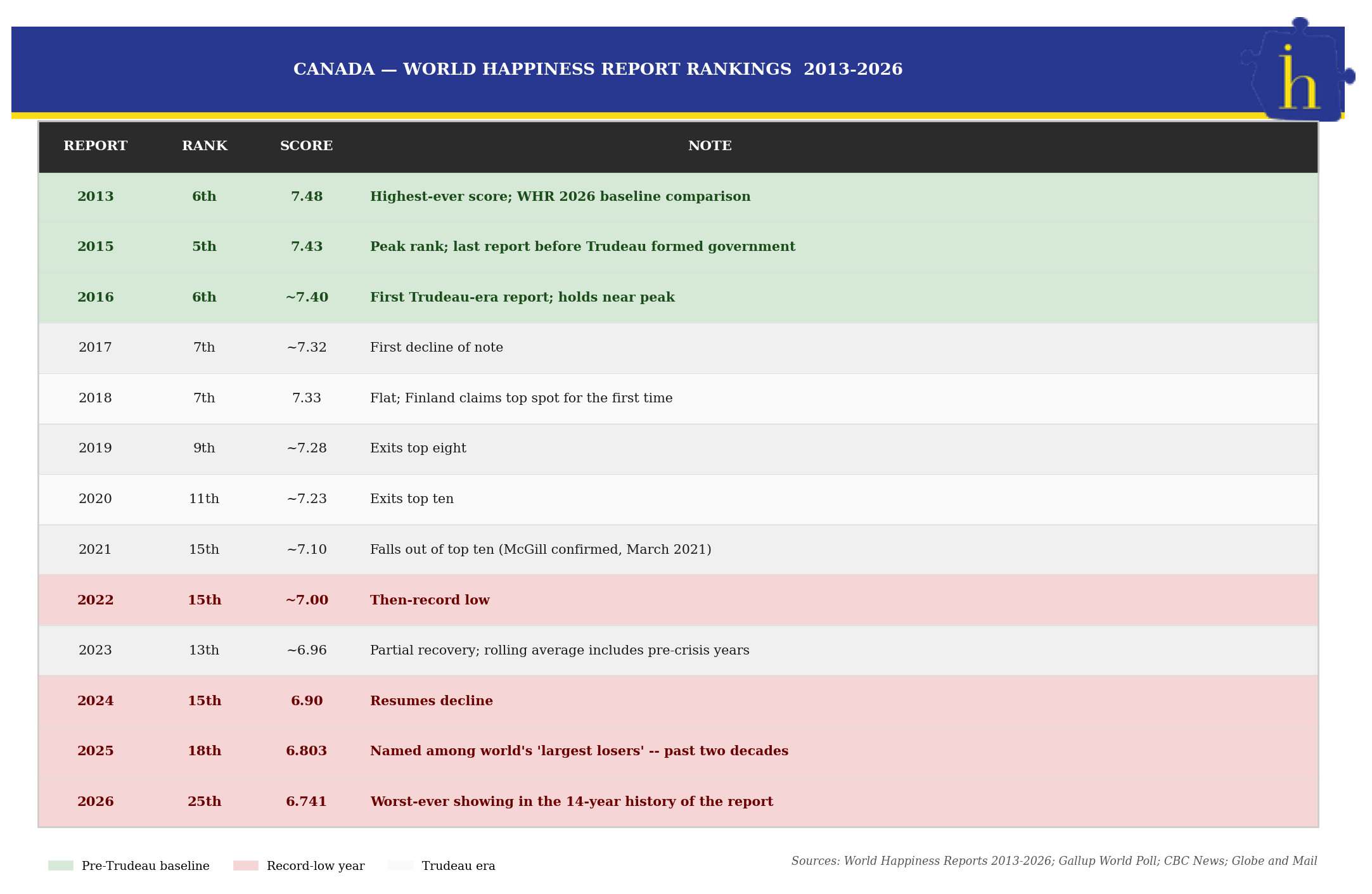
From fifth to twenty-fifth in a decade. In the country’s worst-ever showing in the fourteen years that the report has been published, Canada ranked 25th out of 147 countries. The Globe and Mail’s coverage was direct: ten years ago, Canadians placed sixth, in the same league as Scandinavians. The official WHR 2026 chapter on stability and change named Canada among the industrial countries that were pushed out of the top ten between 2013 and 2026, alongside Austria and Australia. No comparable Western democracy lost more ground on this index across the same period.
Canada has dropped 20 rank positions since Trudeau formed government in 2015. The score fell from 7.48 in 2013 to 6.741 in 2026. The 2026 report confirmed it as the worst-ever showing since the report launched in 2012.
The direction was interrupted once, in 2023, when the index offered a partial recovery to thirteenth place. That recovery tracked a three-year average that still included pre-deterioration years, and it also captured a period when many Canadians were reporting the simple relief of emerging from pandemic restrictions and confinements. That effect was temporary. By 2024 and 2025, as the rolling average absorbed the full weight of the housing crisis, the cost-of-living collapse, and a decade of structural neglect, the index told the story without sentimentality.
One finding from the 2026 report warrants separate attention. If Quebec were counted as a separate country, it would rank fifth in the world, tied with Sweden. Canada without Quebec falls to thirty-fifth. Quebec’s higher social-program density, lower university tuition, and greater local cohesion appear to maintain life satisfaction in ways the rest of the country has not managed. The federal government Trudeau ran is most directly responsible for the thirty-fifth-place Canada, not the fifth-place one. (A post on this is coming soon.)
THE GROUPS HE CHAMPIONED, MEASURED
Here is a question worth asking precisely: did the Canadians Trudeau most specifically championed (young people, Indigenous communities, LGBTQ+ Canadians, racialized minorities, and women) achieve the happiness his government promised to advance on their behalf?
The answer, from Statistics Canada, the Gallup World Poll, and the World Happiness Report itself, is no. Not one of those groups ends the Trudeau era in a stronger position of well-being than it began.
Young Canadians represent the most striking finding. The 2024 edition of the World Happiness Report introduced age-disaggregated rankings for the first time and placed Canada’s under-thirties at fifty-eighth globally. The 2026 report moved that number to seventy-first. Canada’s story gets even more depressing when only young people under twenty-five are counted: the country falls to seventy-first, another new low. Young people were once, on average, the happiest cohort in Canada. The Globe and Mail’s coverage of the 2026 report stated the finding plainly: now they are the most miserable.
The WHR 2026 primary data are precise about what happened. In the United States, Canada, Australia, and New Zealand, the happiness of people under 25 has fallen by an average of 0.86 points on a 0-to-10 scale over the past 20 years. When compared with 136 countries, Canada’s ten-year drop in life satisfaction among young people is among the largest in the world, placing Canada just four slots from the bottom of the list of largest losers.
Statistics Canada’s 2024 longitudinal data confirmed the domestic baseline. Less than half of Canadians, 48.6 per cent, reported high life satisfaction in 2024, down from 54 per cent in 2021. Among Canadians aged 25 to 34, fewer than four in ten were highly satisfied. Financial difficulty rose from 18.6 per cent of Canadians in 2021 to 32.8 per cent in 2024. Seniors maintained 61.5 per cent high satisfaction.
Indigenous communities received specific attention in Statistics Canada’s 2024 survey series. Only 36 per cent of First Nations people living off reserve, 38 per cent of Metis, and 39 per cent of Inuit reported high life satisfaction. The Assembly of First Nations documents suicide rates among First Nations people at five to six times the non-Indigenous average. Life expectancy for Indigenous Canadians remains approximately ten years below the national figure. The pre-Trudeau baseline for these numbers is harder to pin down: the systematic StatCan survey series on Indigenous well-being did not exist in a comparable form in 2015, so the starting point against which to measure a decade of reconciliation policy is largely undocumented. What is documented are the structural conditions (housing deficits, suicide rates, water advisories) that did not improve.
LGBTQ+ Canadians appeared in the 2024 Canadian Happiness Report as one of the three least satisfied groups in the country, alongside people with low income and Indigenous peoples. Racialized Canadians experienced the sharpest single-group deterioration recorded by Statistics Canada between 2021 and 2024: their rate of high life satisfaction fell from 52.7 per cent to 40.6 per cent, a collapse more than five times the rate recorded for non-racialized Canadians.
On women, the picture is layered. Research from the National Bureau of Economic Research and the Journal of Population Economics finds that men now report higher happiness and life satisfaction by measurable margins -- a reversal of historical patterns that accelerated precisely during the period when Canada was governed by a self-described feminist prime minister. The reversal has a partial explanation the government never publicly confronted.
Under the same feminist cabinet, a series of policy and legal changes systematically narrowed the competitive and institutional spaces that women had spent decades building. Bill C-16, extending human rights protections to gender identity and expression, produced a cascade of institutional decisions: sports governing bodies rewrote eligibility rules, female-only competitive categories were opened to biological males, and women who objected faced human rights complaints and social sanction.
The women the feminist government claimed to champion were losing athletic titles, scholarship opportunities, and the protection of single-sex spaces to people the same government had legally reclassified as women. Well-being data for Canadian women during this period reflect, in part, what happens when the political project nominally dedicated to women’s advancement treats the category of woman as a matter of bureaucratic discretion.
THE PROMISES AND THE RECORD
Electoral reform was the promise Trudeau himself, in his departure speech, named as his greatest regret. The 2015 election would be the last under first-past-the-post, he told Canadians. His majority government, obtained with 39.5 per cent of the popular vote, gave him full constitutional authority to deliver. He chose not to, dissolved the all-party committee that had recommended proportional representation, and closed the file in early 2017. The voting system remains. The trust did not.
The boil-water promise expired in public view over six years. Trudeau had campaigned on it personally, naming specific communities, pledging a deadline of March 2021. The Auditor General of Canada, in a 2025 report that rated Indigenous Services Canada’s progress as unsatisfactory, found that 35 long-term advisories remained nationally as of April 2025, including nine that had persisted for more than a decade.
The government’s own tracker, as of mid-2026, shows 38 long-term drinking water advisories in effect across 36 communities. The number has risen since Trudeau left office, not fallen. Neskantaga First Nation, which Trudeau had visited as a symbol of his commitment, has been under a boil-water advisory since 1995. Remedies are not expected to be completed until Fall 2026.
Housing was the defining policy failure. The Trudeau government ran immigration at volumes that reached more than one million net new residents per year at its peak, without proportionate investment in housing supply, infrastructure, or public services. The result was a structural pricing shift that permanently altered the calculus of young adult life: whether to rent or own, whether to start a family, whether to stay. The World Happiness Report registered exactly this. Young Canadians rate their own lives at seventy-first in the world. Housing policy produced that result.
On climate, the government purchased the Trans Mountain Pipeline, stymied oil and gas extraction, and built carbon pricing that became politically toxic without bending Canada’s emissions curve to the targets its own legislation prescribed. The leading explanation for the decline in young people’s well-being, according to University of Alberta economics professor Haifang Huang, who analyses happiness data, is economic: significant increases in food and housing insecurity over the last fifteen years among Canadians between the ages of twenty and thirty-four. Whoever thought that the promise of growing the economy from the heart out was a good economic plan.
The pattern across every file is identical: an ambitious rhetorical commitment, a bureaucratic apparatus constructed to manage its appearance, and a material outcome that failed the people the rhetoric claimed to serve.
Ceremony without delivery is not policy. Canada got ten years of the performance.
THE GENERATIONAL ISSUE GAP AND THE ELECTION THAT FOLLOWED
By the time the 2025 federal election arrived, the coalition Trudeau had assembled in 2015 had shifted fundamentally along generational lines. Abacus Data tracked Liberal support among Canadians aged 18 to 35 collapsing from 41 per cent in 2015 to 22 per cent by the middle of 2024. The material reasons were documented on every available instrument: housing unaffordable, finances deteriorating, the promise of a stable adult life deferred indefinitely.
What followed in the 2025 election was not a straightforward generational repudiation at the ballot box. Donald Trump’s tariff threats and annexation rhetoric converted the campaign, at least in its final weeks, from a referendum on a decade of Liberal governance into a question of national sovereignty in the face of American pressure. The irony of that frame deserves a sentence. Trudeau’s decade produced a hollowed military, the death of energy infrastructure that would have reduced dependence on American markets, and immigration volumes that overwhelmed the public services Canadians depend on. The party that presided over that erosion of Canadian sovereignty presented itself as Canada’s guardian against American encroachment. Older Canadians, with shorter memories of the preceding record, believed them.
The Trump frame disrupted a voting pattern that had been moving against the Liberals for years. The Abacus Data final pre-election poll, conducted April 24 to 27, found voters aged 18 to 29 breaking Liberal at 46 per cent to Conservative at 32 per cent, an outcome that surprised observers tracking the longer trend. Voters aged 45 to 59 gave the Conservatives their strongest age margin, at 42 per cent to 33 per cent for the Liberals. The 60-plus cohort swung back to the Liberals at 46 per cent to 38 per cent.
The issue-priority divergence is where the generational story remains sharp, regardless of how the votes ultimately broke. Abacus found that concern about housing falls from 36 per cent among voters aged 18 to 29 to 11 per cent among voters 60 and over. Trump anxiety moved in the opposite direction, rising from 18 per cent among the youngest voters to 45 per cent among those 60-plus. Ipsos exit polling confirmed the same split: voters aged 55 and over leaned Liberal, motivated primarily by the Canada-U.S. relationship, with 43 per cent naming it their top driver. Voters aged 18 to 34 prioritised affordability and the cost of living at 42 per cent, with only 18 per cent citing the U.S. relationship. Young Canadians worried about housing. Their elders worried about Trump. The Liberals spoke directly to the elders’ concern.
Structural mechanics compounded the issue. Youth voter turnout, while higher in 2025 than in 2021, remained significantly below that of older Canadians. Elections Canada data confirms the 18-to-24 cohort did not surpass its 2015 peak of 57 per cent. Older Canadians, who break Liberal at substantially higher rates and hold the Trump-relationship concern at substantially higher intensity, turned out at historically consistent levels. Boomers remain the wealthiest Canadian generation by net worth. They own property in markets a decade of Liberal policy inflated. They collect old age benefits the Trudeau government increased. The election aligned with their interests and their fears.
The Liberals ran on defending Canadian sovereignty against American pressure. The same party that killed Northern Gateway, blocked Energy East, neglected the Canadian Armed Forces for a decade, and spent ten years performing international virtue on climate while the country’s infrastructure crumbled was now the self-appointed guardian of the nation. The people who checked their rent statements and grocery bills saw through the reframing. The people whose property values had climbed through the same decade found it convincing enough.
The World Happiness Report does not measure sentiment, narrative, or brand. It measures whether people, asked directly to evaluate the quality of their actual lives, report those lives as good. Canada’s answer, year after year since 2015, moved in one direction. The groups Trudeau most loudly claimed to champion gave the lowest scores. The young people he mobilized now rank 71st in the world. From fifth to twenty-fifth in a decade, with no reversal in sight. The promise of sunny ways met the arithmetic of governance, and the arithmetic won.
Yet, Canadians keep returning to Power the same political vehicle that gave them Justin. Sunny Ways!
Not until that Communist swinging door is released and smacks the Liberal electorate hard in the face will they realize the tyranny upon them; the prison to which they have subjected their sons and daughters. They are a disgraceful, ignorant cohort. Alberta needs independence in order to kick Canadian progressive"values" the hell out!
Great essay, friend.
Excellent Canadian journalism.
It really captures the decay, destruction, and diminishment of the Lost Liberal Decade.
History will not view the Liberal Governments with much admiration; the Canadians who supported them repeatedly will be admired even less.